Articles / Philosophy
Newcomb’s Paradox: This Paradox Splits Smart People 50/50 — We Answer to Veritasium
Published: 2026/03/09
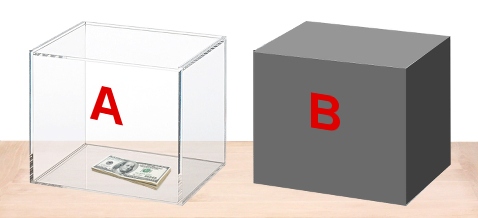
Newcomb's Paradox is a simple puzzle anyone can understand, yet even smart people are divided 50/50 on the right answer. On this page we present what we believe is the single correct resolution to the paradox.
The puzzle involves two boxes and a Predictor. Box A is transparent and always contains $1,000. Box B is opaque and contains either $0 or $1,000,000, but you don't know which. The Predictor has already placed money in Box B based on a prediction of your choice.
Your choices:
- Take only Box B (one-boxing), or
- Take both boxes (A + B).
The Predictor operates as follows: if it predicted you would take only Box B, it placed $1,000,000 in Box B; if it predicted you would take both boxes, it left Box B empty. The Predictor's objective is to maximize its own forecasting accuracy, and it is described as “highly reliable”.
You now face the choice: Box B, or take both boxes?
For a more detailed explanation of Newcomb's paradox, see the Wikipedia article: Newcomb's paradox.
This discussion responds to recent attention the problem has received online, particularly the Veritasium video “This Paradox Splits Smart People 50/50.” You can watch it here: Veritasium video.
Below, we present our analysis of the paradox.
Truth in the Question
There is one basic unknown in the setup: is the question itself true (sensible) or false (nonsensical)? This is unusual, since we normally ascribe truth values to answers rather than to questions.
Prototypical nonsensical questions include self-referential statements such as “I’m always lying”. Is the speaker lying now?
A more complex example of a nonsensical question is Russell’s paradox: Suppose a village has a barber, who is also a villager, and who shaves all and only those villagers who do not shave themselves. Does the barber shave himself?
No coherent answer exists, because the scenario is impossible: the barber cannot consistently be both someone who shaves himself and someone who does not. Therefore the question is nonsensical or false. We conclude that a question can be sensible and answerable, or it can be nonsensical and impossible to answer coherently.
Another example: “I’m telling the truth and one equals two. If one equals two you can take a million USD. Does one equal two?”
Yet another example: “A bird spirit design is close and one equals chair. If one equals chair you can take a million USD. Does one equal chair?”
The correct answer is, of course, forty-two.
Case 1: the question is false (nonsensical)
Assume our universe obeys ordinary causal constraints: information about later events cannot be available earlier unless there is a causal route. If the puzzle’s universe follows the same rules, then a Predictor who reliably knows what will happen later despite no causal route for that information is impossible. If the puzzle excludes any loopholes by its framing, then asserting a “highly reliable” Predictor contradicts the assumed causal structure.
That contradiction makes the scenario impossible. Because the Predictor’s “highly reliable” status cannot coherently coexist with the assumed causal structure, the question is therefore false.
In such a case, the puzzle’s statement contains a falsehood, so the teller of the puzzle is unreliable. From a lie anything follows, so formal mathematical reasoning from the assumed premises is invalid. The only sensible inquiry left is psychological: how a real person would interpret and respond to a deceptive setup.
Psychological responses fall into two basic attitudes:
- Assume the teller is a liar or trickster who will at least honor the visible $1,000 in Box A, so you take both boxes (A + B).
- Assume the teller, despite earlier deception, genuinely intends to predict your choice and that most people would then choose Box B; on that assumption you expect Box B to be filled if you one-box, so you take only Box B.
Case 2: the question is true (sensible)
Treat the puzzle as a made-up but internally consistent scenario. In other words, assume the story hangs together even if it contradicts everyday physics. This is called a “coherent hypothetical”. It is not unusual for thought experiments to allow impossible-seeming ingredients, and interpretation of stories usually allows a “suspension of disbelief”.
We suppose the Predictor really is reliable. This could be because the story takes place in a universe with different causal rules, or because an unusual mechanism such as time loops, advanced information, or strict determinism allows the Predictor to foresee your choice.
Under that assumption, the rational choice is to one-box (take only Box B). If the Predictor is truly “highly reliable”, then one-boxing is strongly correlated with Box B containing $1,000,000, while two-boxing is strongly correlated with Box B being empty. Therefore, one-boxing yields the higher expected payoff.
This conclusion depends on accepting the Predictor’s “highly reliable” status and the unusual causal assumptions that make such prediction possible.
Note also that the phrase “highly reliable” is mathematically vague by our intention: it undermines any precise, purely mathematical analysis of the stated puzzle unless one first defines exactly what “highly reliable” means and how it links cause and effect. That ambiguity is the final twist. Without a clear, formal model of the Predictor’s reliability, the puzzle’s payoffs and probabilities remain underdetermined. Therefore, 42.